France is Burning
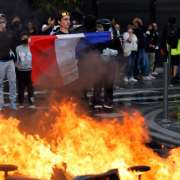
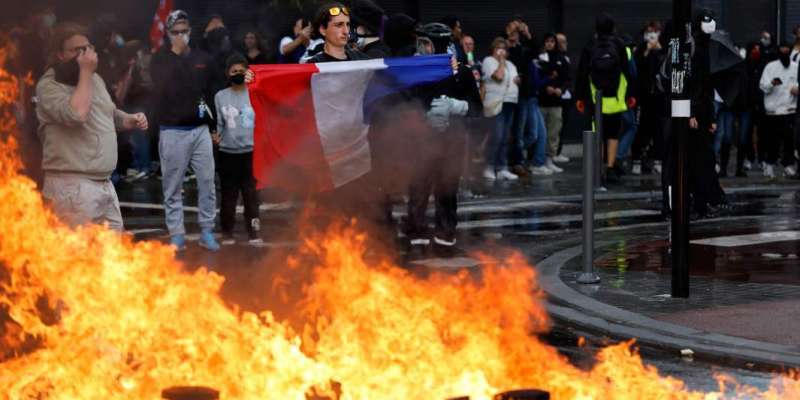
The images of the fires, clashes and looting that have rocked France in recent days have been seen around the world. In many respects, this marks the end of the ‘end of history’. It is not a revolution, but there is certainly a shared sense of the archaic nature of capitalism, with its artificial scarcity and its logic of war. The protests and the unfolding crisis in France have distinctive features.
The crisis of French imperialist hegemony
In recent decades, we have witnessed a slow decline in French imperialism, compared with that of the United States and the European Union itself (which has always championed a bellicose stance and supported the war against Russia). The resurgence of anti-imperialism has enabled several Central African nations (Burkina Faso, Mali and Niger) to free themselves definitively from subordination and Franco-US military control. The pan-African process promoted by Burkina Faso is beginning to erode consensus even in other African nations historically ‘subject’ to France. In the Middle East, France is nothing more than a force supporting US and Zionist interests. France maintains several colonies across all continents, but even in this context, protest movements are very strong, as in the case of the Kanak movement in ‘New Caledonia’.
The crisis of French capitalism
In France, we are witnessing social polarisation on an unprecedented scale. We are talking about social polarisation, not absolute poverty. France remains an imperialist metropolis that still practises unequal exchange with the peoples of the Global South. Social polarisation means that there is an ever-widening gap between the monopolistic bourgeoisie and the working masses in France. Added to this is the neo-colonial dimension affecting almost 20-30 per cent of the French population (the various generations affected by colonisation). This dimension is particularly pronounced in the working-class neighbourhoods of large urban centres, where this ‘racialised’ proletariat is concentrated.
This crisis is also affffecting the French imperialist state itself, which, within the framework of the war economy, is pursuing a process of fascistisation of society. We speak of fascistisation rather than fascism, because today the problem is not militias or neo-Nazi groups (which do exist and are, in any case, developing amidst social and political polarisation), but the authoritarian turn of ‘imperialist democracy’.
Where does the protest movement stem from?
One cannot grasp the scale of this movement without taking into account the emergence, over the past month, of a major protest movement that has sprung up in secondary schools, particularly those located in working-class neighbourhoods of large cities.
This movement has organised demonstrations, roadblocks and strikes, led by young people under the age of 18, often experiencing their fifirst ‘political’ and militant engagement.
Their demands were simple: they want a public school system that works!
But limiting ourselves to these simple (and important) demands does not help us to understand either the reasons behind the protest or the radical nature of these young people’s struggle. Central to this is the issue of dignity, constantly trampled upon by the neocolonial police (working-class neighbourhoods suffer constant attacks by the police) and by widespread social precarity.
We are witnessing a new process of ‘apartheid’ within the imperialist metropolis, within an imperialist war economy that identififies its internal enemy in certain sections of the working classes, predominantly those who are racialised and of Muslim tradition.
The government’s response to the students has been extremely violent. There are reports of over 8,000 arrests (in France, in May ’68, the fifigure reached almost 2,000). Eighty per cent of those arrested are minors.
17 October
It is against this backdrop that the events of 17 October ‘erupted’, when, spurred on by the secondary school students’ movement, other social and political sectors took to the streets. A series of demonstrations and looting followed, spreading throughout France and putting the police and the government itself on the back foot; the government is now calling in the army and implementing increasingly repressive and militarised measures (curfews, indiscriminate arrests, etc.). In an increasingly stiflfling climate of war, the movement aims to spur on new mobilisations.
However, it would be a mistake to think that France today is divided between the 99 per cent and the 1 per cent of ‘the rich’. In France, there is a broad, mass reactionary movement demanding ever harsher policies against the racialised proletariat, against the unemployed, and so on. It demands the banning of left-wing political forces, including the dissolution of the main left- wing party (La France Insoumise, LFI). A party such as LFI (although it would be more accurate to speak of a political-social front) is accused of politically representing this racialised proletariat and the masses of precarious workers living in the urban suburbs.
The disruptive social force of the demonstrations and protests that have shaken France must be harnessed politically – in the balance of power, in the capacity for organisation in workplaces, in working-class neighbourhoods, in schools and in prisons. The social impact of the recent demonstrations has revealed a scope far broader than that of a strike; we live in an urban environment where the boundary between work and non-work is increasingly blurred. Left-wing forces have called for a general strike, but the protests go far beyond mere trade union rhetoric.
We cannot predict how long the movement will last, nor the various decisions the government will take; however, we must avoid squandering this social force and its capacity to destabilise the governing apparatus of the French imperialist state.
Subscribe to stay up-to-date