Wherever There Is Resistance, That Is the Centre of the World…
It is reported that Palestinian prisoners in the occupied territories are to be given the death penalty.
We regard all Palestinian revolutionary prisoners sentenced to death, especially those of the PFLP, as our own prisoners.
We will unite our resistance.
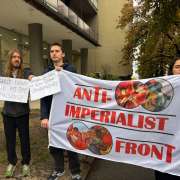
We will organise resistance everywhere we are against the execution of the Palestinian people, especially the Front prisoners.
From the prisoners of the Front in pit-type prisons to the resisting prisoners in Palestine, we will stand together and hold onto one another.
The families of Palestinian prisoners and the Palestinian people, together with TAYAD families, will stand together.
The decision by Zionist Israel to impose the death penalty is an attempt to physically destroy the Palestinian resistance, which it has failed to defeat ideologically.
Wherever there is resistance is the heart of the peoples of the world, their lifeline.
The most noble lifeline of the world is those who resist imperialism and fascism.
The peoples of the world will struggle against the cutting of this lifeline, against the attempt to stop this heart.
Just as Front prisoners in pit-type prisons resist to the death, PFLP prisoners continue to resist, year after year, against all forms of torture imposed by Israeli Zionism.
They will not be able to destroy the just and honourable struggle of the Palestinian people through the death penalty — this is not possible.
Because something is coming… something is being born…
From the earth, from fire, and from the sea, the strongest will rise again from among us.
***
A law introducing the death penalty for Palestinian prisoners has been approved in the Israeli parliament.
The parliament of what is described as “murderous Israel,” and this law itself, have no legitimacy, as Israel is characterised as an occupying, violent, and Zionist state.
The land stretching from the Jordan River to the Mediterranean is described as belonging historically to the Palestinian people, not Israel. Therefore, any decision taken by an occupying power is argued to lack legitimacy.
It is further claimed that the purpose of Israel’s establishment, through a United Nations decision, was to serve as an instrument of US influence.
Israel’s National Security Minister, the far-right figure Itamar Ben-Gvir, had previously called for the adoption of such a law. The Israeli parliament’s National Security Committee approved the proposal, paving the way for a parliamentary vote.
In the vote held on 30 March 2026, 62 out of 120 members voted in favour, while 48 voted against.
According to the law passed:
- Individuals who kill an Israeli citizen with the intent of “ending the existence of Israel” may be sentenced to death in Israeli civilian courts.
- In military courts operating in occupied territories, individuals accused of what is defined as “terror offences” may receive the death penalty, even without a prosecutorial request and without the requirement of a unanimous decision.
- The right to appeal death sentences will be largely restricted.
- Those sentenced may be executed within 90 days.
- A Palestinian who kills an Israeli citizen may face the death penalty directly, whereas an Israeli who kills Palestinians will not face this punishment under any circumstances.
The Palestinian people, through the 7 October 2023 Al-Aqsa Flood, delivered what is described as a major blow to Israel and US imperialism. With limited means, they confronted what is presented as a “modern” occupying army and managed to advance approximately 40 kilometres. The Palestinian people showed the world how Israel’s so-called “Iron Dome” could be breached through the will of the people.
Following this resistance, Israel is said to have killed 73,000 Palestinians, including 25,000 women and 25,000 children.
The ideology of the Palestinian people is resistance. It is argued that the land referred to as Israel is in fact Palestinian land, and that Israel’s existence is illegitimate. From this perspective, the Palestinian cause is presented as just, as people defend their homeland, land, and future, declaring: “Where there is occupation, there is resistance.”
It is stated that resistance continues across all sections of society — men, women, and children — under extremely difficult conditions, including hunger and destruction. This resistance is described as rooted in a moral conviction tied to historical justice.
According to this view, those who do not resist oppression risk losing their moral standing, while the Palestinian people have not been defeated either ideologically or physically. Their struggle is described as having gained global support, uniting people across continents, universities, youth movements, and artists, with the Palestinian flag becoming a symbol of solidarity.
It is argued that the introduction of the death penalty law targeting Palestinian prisoners is a response to this resistance — an attempt to physically eliminate what could not be defeated ideologically. This is described as a long-standing method used by those in power.
However, it is also stated that such efforts ultimately fail in the face of what is seen as a just struggle. A people determined to resist cannot be defeated. US imperialism, Israel, and allied powers are described as unable to overcome such resistance despite their strength.
This position argues that imperialism, as the final stage of capitalism, intensifies its aggression in times of crisis, resorting to increasingly harsh methods.
Law is described here as a tool used by ruling classes to legitimise violence, occupation, and repression.
It is argued that Israel is attempting to use the death penalty to legitimise its actions and portray Palestinian fighters as “terrorists.”
Following the vote, Itamar Ben-Gvir stated that the law had passed its first reading, describing it as a fulfilment of promises made by his political movement.
Critics argue that by labelling Palestinian resistance as “terrorism,” the authorities are revealing their broader political intentions, and that political prisoners are being targeted as key figures in the resistance.
Palestinian prisoners, who have resisted various forms of detention — including administrative detention, where individuals may be held for years without formal charges — are now said to face the threat of execution.
It is argued that this is because such prisoners symbolise resistance not only in the Middle East but globally.
Reports also indicate protests against the law, including within Israel and across the region.
According to the claims presented:
- Executions would be carried out by masked guards, whose identities would remain secret.
- Those carrying out executions would be granted full legal immunity.
- Prisoners would be denied meaningful rights of appeal.
- Individuals sentenced to death would be held in complete isolation, in underground cells, without visitation rights.
- Military courts in occupied territories would have the authority to impose death sentences without requiring prosecutorial request or unanimous decisions.
These measures are described as lacking legitimacy and reflecting fear of accountability.
Wherever There Is Resistance Is the Heart of the World, Its Lifeline!
The Most Noble Lifeline of the World Is Those Who Resist Imperialism and Fascism!
Those who achieve victory are only those who resist. The only barrier against imperialism, fascism, and Zionism is resistance. As long as the Palestinian resistance continues, Israel will remain unable to achieve its aims.
In order to conceal their own weakness, they seek to render the people powerless. These illegitimate laws become weapons of war in the hands of the occupiers. Through the law, they attempt to demonstrate their “strength” and spread fear through executions. But they have not succeeded, and they will not succeed. The Palestinian resistance has continued for seventy years.
With the responsibility to stand beside anyone who throws even a single stone against imperialism, we declare:
We consider all Palestinian revolutionary prisoners sentenced to death, especially those of the PFLP, as our own prisoners.
Just as revolutionary prisoners in pit-type prisons resist to the death, PFLP prisoners have continued to resist for years against all forms of torture imposed by Israeli Zionism.
Today, there are three centres of resistance for the peoples of the world: one in Anatolia, where Front prisoners resist in pit-type prisons; one in Palestine, turned into an open prison; and one in Iran.
For the peoples of Anatolia and revolutionary movements, Palestine has held a central place since Kızıldere. The leader of the Anatolian revolutionary movement, Mahir Çayan, made this struggle known by holding accountable the Israeli Consul General Efraim Elrom in Istanbul.
Since then, the struggles of the two peoples have been understood as directly connected. Palestinian mothers have even named their children after Mahir. Since 1971, this shared tradition of resistance has created a bond rooted in both resistance and solidarity.
For this reason, we say that Palestinian prisoners will resist against the death penalty. We know this from our own experience, as we continue to resist in conditions where even air, sunlight, and sound are restricted. Just as in Gaza, where the entire population is subjected to conditions resembling these prisons, they now attempt to impose submission through executions.
The leader of the Vietnamese revolution, Ho Chi Minh, once said:
“Do not forget; storms are opportunities for pines and plane trees to prove their strength. This storm will pass. Hold firmly to one another.”
We will hold onto one another — Front prisoners in pit-type prisons,
resisting prisoners in Palestine, and all Palestinian prisoners.
The families of Palestinian prisoners, the Palestinian people, and TAYAD families will stand together.
Because, as Lenin taught us: Internationalism is the safest refuge of the peoples.
We will unite our resistance. We will organise resistance everywhere against the execution of the Palestinian people, especially Palestinian Front prisoners.
Lenin tells us: Internationalism is the brotherhood of peoples.
And as Che Guevara said: “The most important thing is to always be able to feel any injustice committed against anyone, anywhere in the world, as if it were committed against you.”
After 7 October 2023, despite all efforts to portray resistance as terrorism, people across the world stood with the Palestinian struggle. Millions took to the streets, organising actions in solidarity. While imperialist powers raised Israeli and Ukrainian flags, the peoples of the world carried the Palestinian flag despite bans.
The death penalty law is presented as proof of the illegitimacy, weakness, and exposure of the Israeli state. The peoples of the world must unite against this law and against the execution of Palestinians. Those who do not do so today may face similar repression in the future.
Imperialism and its allies draw strength from silence. Their greatest fear is organised people. Their boldness today is attributed to the lack of organisation among the people.
It is argued that the heavy price paid by Palestine is due to it being one of the few places where organised resistance continues. In Turkey’s prisons, revolutionary prisoners continue to resist; in Gaza, Palestinians continue to resist.
For neo-colonial countries, the strategy of liberation is described as PASS (Politicised Military War Strategy). The strength of the peoples lies in organisation and unity.
We will resist together against attempts to impose submission through executions in Palestine.
Only Those Who Resist Achieve Victory
And We Will Continue to Resist Until Victory!
Israel, which has failed through occupation, will also fail through executions.
We will continue to resist against occupation, death sentences, and pit-type prisons.
Down with Imperialism, Down with Zionism!
Subscribe to stay up-to-date